
For US Healthcare Professionals
For US HCPs

You are about to leave a GSK website
You are about to leave a GSK website. By clicking this link, you will be taken to a website that is independent from GSK. The site you are linking to is not controlled or endorsed by GSK and GSK is not responsible for its content.
Stronger systems. Healthier communities. One patient at a time.
At GSK, we are committed to supporting health systems in their vaccination efforts, helping you protect your community, and improve population health.
This web page offers information and resources for population health decision-makers on key topics related to improving vaccination rates, understanding the increasing role vaccines play in quality scores, reducing hospitalizations and readmissions, and identifying vaccine-eligible patients in health systems. Explore more below.
VACCINE QUALITY MEASURES
How do adult vaccination rates affect your CMS quality scores?
The Adult Immunization Status (AIS) measure is gaining traction as a core HEDIS® quality measure, and it has been revised to include additional vaccines to report beyond pneumococcal and influenza vaccines.1-4,a
The AIS measure assesses the proportion of adults who are up to date on influenza, herpes zoster (shingles), pneumococcal, Td or Tdap, and hepatitis B vaccinations.4
As of 2025, the AIS measure is now:

Part of the CMS Universal Foundation set, replacing the stand-alone influenza and pneumococcal vaccine measures2,5

Available for selection in Merit-Based Incentive Payment System (MIPS) and MIPS Value Pathways (MVP)5,6,b,c

Included in the 2026 Medicare Star Ratings display page based on the 2024 measurement year3,d
Beyond financial incentives, opting in to report the AIS measure can help your health system:
- Meet CMS requirements for systems' vaccination rates5,6
- Better understand your vaccination rates7
- Identify gaps and address disparities in underserved populations7,8
- Streamline reporting across value-based care programs9
For more information on the benefits of the AIS measure and reporting requirements for MIPS, review the resources below.


ADULT VACCINATION RATES
What percentage of adults are up to date with recommended vaccinations?
Less than 25% of adults are up to date on routinely recommended vaccines (influenza, herpes zoster [shingles], pneumococcal, and Td or Tdap).16 Efforts to vaccinate can lead to fewer hospital admissions and readmissions for vaccine-preventable diseases, helping to alleviate the strain on health systems.17
Estimated adult vaccination rates for CMS-monitored vaccines16,18,19,e

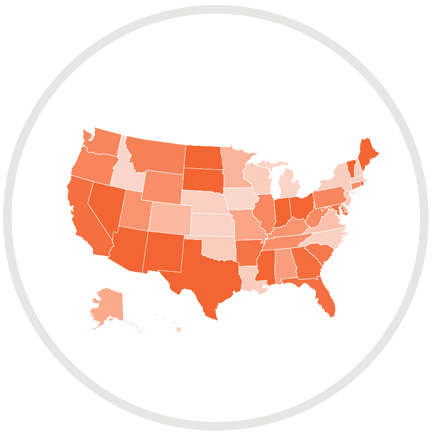
Learn more about vaccination trends in your state.
AT-RISK POPULATIONS
Which populations in your health system could be at risk for negative outcomes?
1. Older adults
Chances of hospitalization and readmission from vaccine-preventable diseases increase as people age due to waning immunity and comorbidities.20,21 Clinical studies have reported thirty-day readmission rates for older adults hospitalized for common vaccine-preventable diseases:

(see footnote k for study details)

(see footnote k for study details)

(see footnote l for study details)
2. Patients with comorbidities
Vaccine-preventable diseases can worsen preexisting medical conditions or cause new long-term health complications.24


3. Racial and ethnic minority groups
Black and Hispanic patients are less likely to receive age-appropriate adult vaccines compared with White and Asian patients and more likely to be hospitalized with a vaccine-preventable disease.16
Adults up to date on all vaccinations in the composite vaccination measure (including influenza) by race and ethnicity, 202216,p

When compared with White and non-Hispanic patients, respectively:


Know your system's immunization rates and identify eligible patients who are not up to date on recommended vaccines.

Shingles Epic EHR guides
Use these guides to help identify patients eligible for the shingles vaccine and schedule timely automated outreach. Additional EHR guides will be released soon.

Alternative EHR guides
Get the information you need to identify gaps in care, ensure vaccine administration and maintenance, and improve the quality of care using Oracle Cerner, Meditech, and more on GSKPro.com.
EHR=electronic health record.
Use the following resources to support referral protocol and identify ways to improve vaccination rates within your health system.

Add EasyVax to your health system’s referral protocol.
When in-office vaccination is not possible, EasyVax is a mobile-friendly website patients can access to immediately schedule vaccinations. This printable poster explains how to scan and schedule a vaccine appointment without the hassle. Make sure the physicians in your health system are aware of this service and distribute these posters to patients.

Watch a webinar recording tailored to health systems looking for actionable ways to increase vaccination rates.
This webinar focuses on recent changes to vaccination reporting requirements and features a case study demonstrating how a health system successfully increased its vaccination rates using best practices.
Make use of the following clinical resources to support vaccination efforts within your health system.
For immunization schedules and strategies, explore the following resources from CDC.gov.
Find resources designed to address various aspects of immunization on Immunize.org.
References
National Committee for Quality Assurance. HEDIS® 2019 Volume 2: Technical Update. October 1, 2018. Accessed July 29, 2025.
The Universal Foundation. Centers for Medicare & Medicaid Services. Updated June 26, 2025. Accessed July 29, 2025.
Announcement of calendar year (CY) 2025 Medicare Advantage (MA) capitation rates and Part C and Part D payment policies. Centers for Medicare & Medicaid Services. April 1, 2024. Accessed July 29, 2025.
HEDIS® MY 2025 measures and descriptions. National Committee for Quality Assurance. Accessed July 29, 2025.
Calendar year (CY) 2024 Medicare physician fee schedule (PFS) final rule fact sheet and policy comparison table. Centers for Medicare & Medicaid Services. Accessed July 29, 2025.
2024 MIPS clinical quality measure specifications and supporting documents: Quality Payment Program. Quality ID #493 (CBE 3620): Adult Immunization Status. Quality Payment Program. December 2023. Accessed July 29, 2025.
Esselman K, Ciemins EL, Donckels E, Barbera C, D’Andrea G, McBride T. Using quality measures to drive improvements in immunization rates: findings from a real-world evaluation from 3 US health care organizations. Popul Health Manag. 2022;25(3):423-429. doi:10.1089/pop.2021.0197
Rodrigues CMC, Plotkin SA. Impact of vaccines; health, economic, and societal perspectives. Front Microbiol. 2020;11:1526. doi:10.3389/fmicb.2020.01526
CQMC announces updates to eight core measure sets. News release. AHIP. August 17, 2023. Accessed July 29, 2025.
Number of HEDIS® covered lives tops 200 million. National Committee for Quality Assurance. January 12, 2022. Accessed July 29, 2025.
Merit-based Incentive Payment System (MIPS): traditional MIPS scoring guide for the 2022 performance year. Quality Payment Program. Accessed July 29, 2025.
How MIPS eligibility is determined. Quality Payment Program. Accessed July 29, 2025.
Learn about the MVP reporting option. Quality Payment Program. Accessed July 29, 2025.
Calendar year (CY) 2025 proposed and modified Merit-based Incentive Payment System (MIPS) Value Pathways (MVPs). Quality Payment Program. Accessed July 29, 2025.
Advance notice of methodological changes for calendar year (CY) 2024 for Medicare Advantage (MA) capitation rates and Part C and Part D payment policies. Centers for Medicare & Medicaid Services. February 1, 2023. Accessed July 29, 2025.
Vaccination coverage among adults in the United States, National Health Interview Survey, 2022. Centers for Disease Control and Prevention. October 4, 2024. Accessed July 29, 2025.
Doherty MT, Aris E, Servotte N, Beck E. Capturing the value of vaccination: impact of vaccine-preventable disease on hospitalization. Aging Clin Exp Res. 2022;34(7):1551-1561. doi:10.1007/s40520-022-02110-2
Flu vaccination coverage, United States, 2023-24 influenza season. Centers for Disease Control and Prevention. September 20, 2024. Accessed September 3, 2025.
Vaccination coverage among adults in the United States, National Health Interview Survey, 2021. Centers for Disease Control and Prevention. July 19, 2024. Accessed July 29, 2025.
Al-Jabri M, Rosero C, Saade EA. Vaccine-preventable diseases in older adults. Infect Dis Clin North Am. 2023;37(1):103-121. doi:10.1016/j.idc.2022.11.005
Pennisi F, Borlini S, Cuciniello R, et al. Improving vaccine coverage among older adults and high-risk patients: a systematic review and meta-analysis of hospital-based strategies. Healthcare (Basel). 2025;13(14):1667. doi:10.3390/healthcare13141667
Ackerson B, Tseng HF, Sy LS, et al. Severe morbidity and mortality associated with respiratory syncytial virus versus influenza infection in hospitalized older adults. Clin Infect Dis. 2019;69(2):197-203. doi:10.1093/cid/ciy991
Jain S, Khera R, Mortensen EM, Weissler JC. Readmissions of adults within three age groups following hospitalization for pneumonia: analysis from the Nationwide Readmissions Database. PLoS One. 2018;13(9):e0203375. doi:10.1371/journal.pone.0203375
Recommended vaccinations for adults. Centers for Disease Control and Prevention. July 1, 2025. Accessed July 29, 2025.
Woodruff RC, Melgar M, Pham H, et al. Acute cardiac events in hospitalized older adults with respiratory syncytial virus infection. JAMA Intern Med. 2024;184(6):602-611. doi:10.1001/jamainternmed.2024.0212
Restrepo MI, Reyes LF. Pneumonia as a cardiovascular disease. Respirology. 2018;23(3):250-259. doi:10.1111/resp.13233
Kwong JC, Schwartz KL, Campitelli MA, et al. Acute myocardial infarction after laboratory-confirmed influenza infection. N Engl J Med. 2018;378(4):345-353. doi:10.1056/NEJMoa1702090
Chandrasekhar R, Sloan C, Mitchel E, et al. Social determinants of influenza hospitalization in the United States. Influenza Other Respir Viruses. 2017;11(6):479-488. doi:10.1111/irv.12483